GAINS — Global Artificial Intelligence and Nature Solutions — builds
scientific tools and decision support for governments, universities,
NGOs, and industry. We treat AI and Earth observation as instruments to
test and scale ecological theory, not as a substitute for mechanism.
Mission
Scale ecological theory with GeoAI and structural equation modeling
to sustain forest carbon and biodiversity under climate change —
including resilience to extremes, early warning of tipping points,
JREDD+, Net Zero, and nature-based solutions.
Vision
An international research institute bridging field ecology,
multi-sensor remote sensing, and AI for transparent carbon MRV,
climate-risk assessment, restoration design, and early warning of
ecosystem tipping points.
Core values
Theory first. Evidence over black boxes. Open methods where possible.
Partnerships that serve climate adaptation, resilience, and
biodiversity priorities.
Scope
Tropical forests, mangroves, urban greenspace, agroforestry,
agricultural production, and coastal systems under intensifying
climate extremes — with methods that transfer across tropical and
subtropical landscapes.
Policy alignment
GAINS research is aligned with — not a substitute for — major
international agendas for climate and biodiversity action.
SDG 14 — Life Below Water
Mangroves, blue carbon, and coastal systems
SDG 15 — Life on Land
Tropical forests, biodiversity–ecosystem functioning, restoration
GBF Target 2Ecosystem restoration and trait-based recovery design
GBF Target 3Conservation co-benefits for biodiversity and carbon
GBF Target 8Minimize climate impacts on biodiversity; early warning of tipping risk
GBF Target 11Nature’s contributions to people — multifunctionality and carbon services
GBF Target 21Science, data, and GeoAI for decision-ready biodiversity and carbon knowledge
Research programs
Seven themes that define GAINS
Organized research programs spanning forest carbon, climate extremes and
tipping points, biodiversity, AI for Earth, remote sensing, digital
twin forests, and climate-smart agriculture.
01
Forest Carbon & Climate Change
Carbon accounting, sequestration, carbon stability under a changing
climate, MRV, JREDD+, and Net Zero pathways for forests and blue
carbon — including contributions to global mangrove soil-carbon
mapping collaborations.
02
Climate Extremes, Resilience & Tipping Points
Cyclones, heat, drought, salinity, and compound extremes; recovery
trajectories; critical slowing down (CSD); long-term vegetation
signals (e.g. kNDVI); and early warning of ecological tipping points.
03
Biodiversity & Ecosystem Functioning
Functional composition, multifunctionality, structural diversity,
and ecological modeling with SEM — how biodiversity sustains
function under climate stress.
04
AI for Earth
Machine learning, deep learning, GeoAI, foundation models, and
explainable AI for monitoring, resilience forecasting, and decision
support.
05
Remote Sensing
Satellite, drone, TLS/LiDAR, hyperspectral, radar, GEDI, Planet,
and MODIS — fused for multi-scale observation of change, extremes,
and recovery.
06
Digital Twin Forests
Living digital representations of stand structure, carbon,
resilience, and tipping risk — linking plots, UAV/LiDAR, and
satellite time series.
07
Climate-Smart Agriculture & Precision Production
Climate-risk assessment and crop-yield forecasting using Earth
observation, field data, and GeoAI; precision irrigation,
nutrient, and crop-stress management for resilient, resource-
efficient, and sustainable agricultural production.
Institute profile
How we monitor, analyze, and act
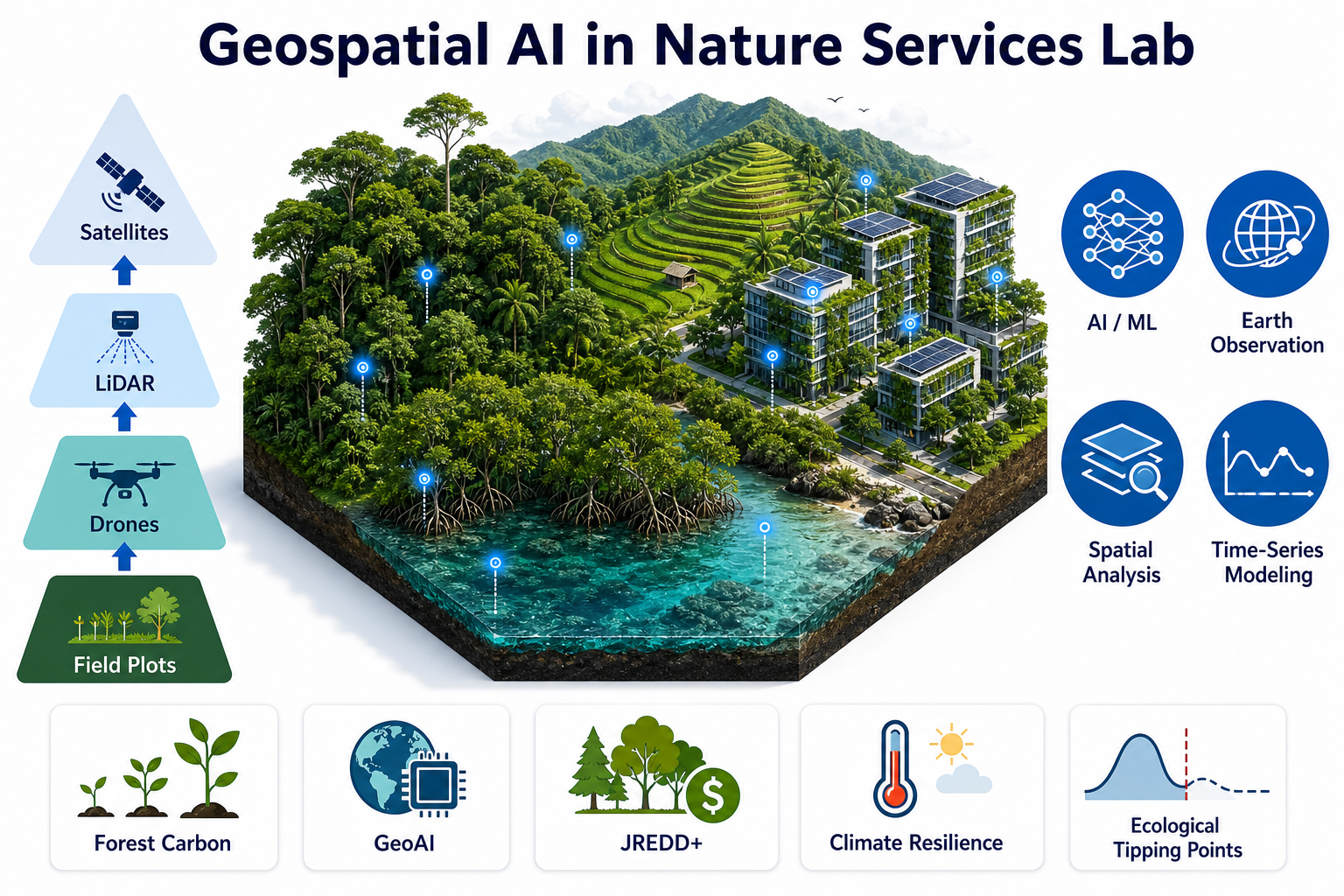
Multi-scale monitoring, GeoAI analysis, and application pillars —
including forest carbon, climate resilience, ecological tipping points,
and precision agriculture across urban, tropical, coastal,
agroforestry, and agricultural landscapes.
Publications
Evidence in leading venues
Selected papers by venue. Full list on Google Scholar (1,550 citations;
h-index 14; i10-index 19 — as of September 2026).
Founder & Director, GAINS · Research Fellow, Remote Sensing Laboratory,
The Hong Kong Polytechnic University
Forest ecologist with a decade of experience across Kyoto University,
NASA Goddard Space Flight Center, The University of Hong Kong, Jiangmen
Laboratory of Carbon Science and Technology (HKUST Guangzhou), and The
Hong Kong Polytechnic University. His work integrates field ecology,
UAV/LiDAR, satellite remote sensing, GeoAI, machine learning, and
structural equation modeling to understand forest carbon, climate
extremes, ecosystem resilience, and tipping points — with 20+
peer-reviewed articles (1,550 citations; h-index 14; i10-index 19,
Google Scholar, September 2026) in Nature
Communications, Global Change Biology, and Communications Earth &
Environment.
Research interests
Climate change & extreme climate
Ecosystem resilience
Ecological tipping points & CSD
Forest carbon & blue carbon
Biodiversity–ecosystem functioning
Structural equation modeling
GeoAI & Earth observation
JREDD+ & carbon MRV
Nature-based solutions
Digital twin forests
Selected experience
Research Fellow — PolyU Remote Sensing Laboratory
2026–present · Blue carbon, Net Zero trees, campus carbon offsetting
Areas of scientific expertise for future partnerships — not a
commercial service catalog. Engagement depends on collaboration,
institutional approval, and funding.
Carbon accounting and MRV
Climate-risk, extremes & resilience assessment
Tipping-point & early-warning analysis
Forest inventory & biodiversity assessment
UAV and LiDAR surveys
Satellite mapping & Google Earth Engine
AI / GeoAI modeling
Restoration planning under climate change
Carbon credit project science support
Training and capacity building
Engage
Collaborate with GAINS
Pathways we aim to open as the institute grows — enquire by email;
nothing below is an open call or guaranteed program yet.
Partners
Seeking collaborations with universities, agencies, NGOs, industry,
and international organizations.
Training
Coming soon.
Careers
Coming soon.
Coming next
Data portal, open GEE/Python tools, and interactive carbon &
resilience calculators — roadmap only.
Contact
Start a collaboration
Research partnerships on climate extremes, resilience, tipping points,
forest carbon, GeoAI, MRV, training, and institute development — get in
touch.